MS Erfurt Aug. 12°47 — Closing Note
CLIO-7 Manuscript Intelligence System · Institut für Digitale Paläographie, Erfurt
The manuscript described in this edition was found in 2019 in the historical library of the Augustinian monastery at Erfurt, shelved between a breviary and a lectionary. It consists of a small bound booklet of seventeen folios, uncatalogued and materially intact, though abraded, stained, and split by age. If the account of its origin is correct, it may have remained there, unexamined, for approximately five hundred and sixty years.
The narrator is called Konrad once, when another man addresses him in the workshop. Konrad was among the most common given names in fifteenth-century Germany. No person matching the narrator’s circumstances has been identified with certainty in the surviving records.
At the damaged Eckhart sentence, the three readings do not possess equal material authority. Among the surviving witnesses to Eckhart’s German sermons, the line most readily supports ist — is. A later hand supplies enpfêhet — receives — in the margin of one Cologne witness. Wirt — becomes appears nowhere in the surviving transmission.
The folios reproduced before this note are not photographs of Konrad’s manuscript. They are synthetic reconstructions. The English words attributed to Konrad were extracted from this edition, translated back into a conjectural form of mid-fifteenth-century German, passed to a custom scribe simulator to write them in a hand Konrad might have used, and subjected to simulated age and damage with a weathering simulation.
They are not the source of this translation.
This translation is their source.
Behind the work
A manuscript written from its own translation.
Three programs, run in order. Each one hands the next exactly what a real manuscript would have handed a scholar — and the scholar’s apparatus is where it started.
CLIO-7’s confidence scores and lacunae are written into the folios before the hand ever touches them
01 · XL — authoring
The English, put back into 1457.
The text is rewritten in Late Middle High German in a Thuringian register, then cut into folios. Every line carries its register — German or mixed with Latin — a CLIO-7 confidence score, and any damage the edition says it suffered.
Calfskin folios 1–13 hold 22–24 lines in a 130 × 180 mm text block; the smaller offcuts from folio 14 hold 16–18.
{
  "id": "f04r",
  "recto_verso": "recto",
  "vellum_stock": "standard",
  "lines": [
    { "number": 12,
      "text": "beiden Wochen — daß Peter nicht solde [—] in dem",
      "register": "de",
      "annotations": [
        { "type": "confidence", "detail": { "score": 0.45 } },
        { "type": "lacuna", "detail": { "reason": "water" } }
      ] }
  ]
}

02 · ScribeSim — the hand
A Bastarda hand that feels what the text says.
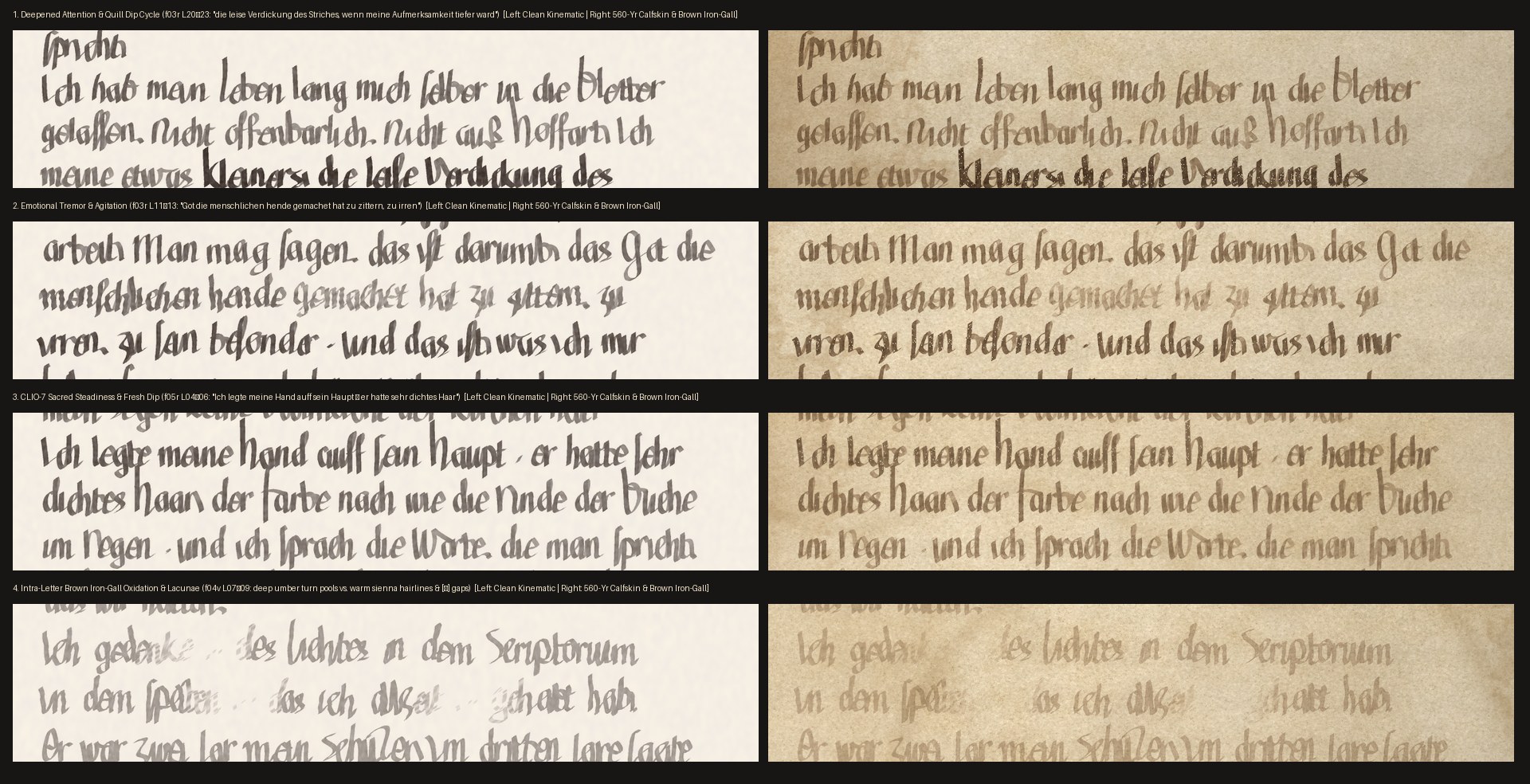
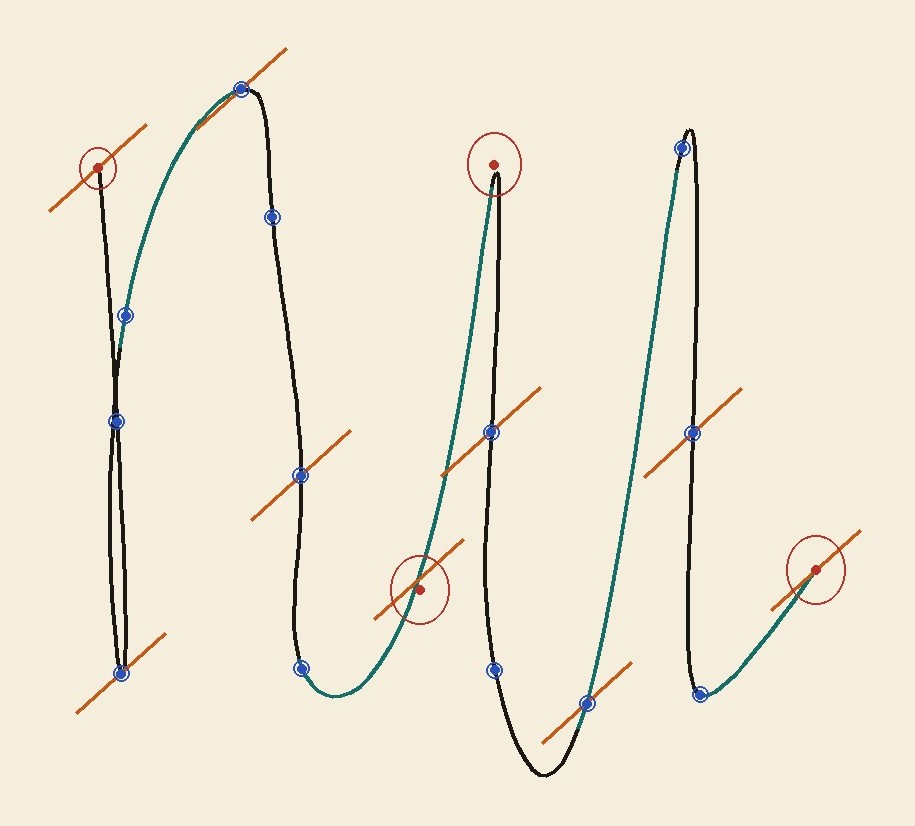
Each folio is a pen path, drawn stroke by stroke at 300 dpi, with the gutter on the correct side for recto and verso. A letter is a few via-points. The word is solved as one motion, so the turn leaving one letter and the turn entering the next are planned together. A chisel nib 0.83 mm wide, held at 40°, sweeps that path. A stroke across the nib goes broad; a stroke along it goes fine. Pressure splays the edge, a slow turn pools ink at the foot, and the quill thins until the next dip. Konrad’s state scales pressure, width, and tempo on that motion. The x-height is 3.5 mm.
Those strokes are five methods, run in order. Each letter is a contextual via-point recipe, measured in nib-widths and chosen for the letters beside it. The word is one minimum-jerk quadratic program: a banded solve draws the path through every point at once, and the boundary points are soft, so neighbouring letters yield to each other. A 40° chisel is swept as quadrilaterals, with tine splay under pressure and ink pooling where the pen slows. An ink-cycle state empties the quill by the distance travelled and refills it at a dip. A scribe-state model drifts tempo, nib angle, and the via-points, and the line’s emotional state scales pressure, width, and speed.
Two of those methods have names. Bastarda hand recovery is the letter: a short recipe of via-points, measured in nib-widths and chosen for the letters beside it. Kinematic coarticulation is the motion: one minimum-jerk solve for the whole word. Points in the body of a letter stay put. Points at the joins are soft, so the exit of one letter and the entry of the next draw toward each other. The same solve writes every pair.
statepressurewidthtempo
deepened attention×1.22×1.13×0.80
grief, hesitation×0.90×0.94×0.76
sacred steadinessdeepened attentiontremor, agitationgrief, hesitationLatin, formalcompensating eyesight
03 · Weather — five hundred years
Damage from first principles, then from a model — never on the letters.
A codex map models the gathering physically: water spreading from folio 4r and decaying by leaf distance, edges darkening by position, foxing mirrored recto to verso. The edition’s word-level damage is applied in pixel space first, exactly as specified.
Only then does an image model age a blank parchment, informed by neighbours already weathered. The background is darkened into the hand, and the ink is shifted from black toward the warm brown of oxidised iron gall.
Water severity = 0.4distance from the epicentre
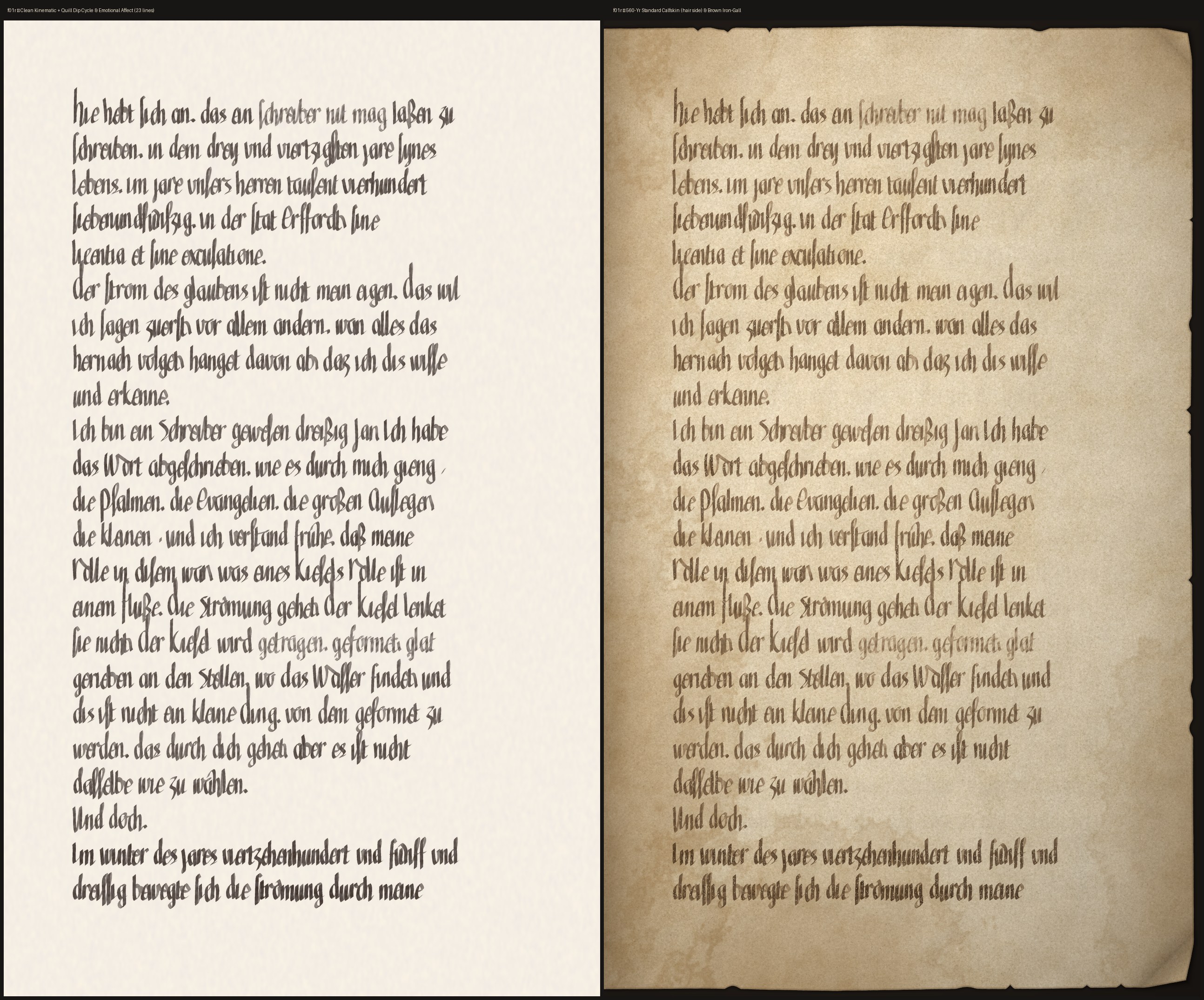
- pages rendered and aged
- 34
- word-level damage annotations honoured
- 88
- lines where the writer’s state shapes the hand
- 254
- times the quill was re-dipped
- 232